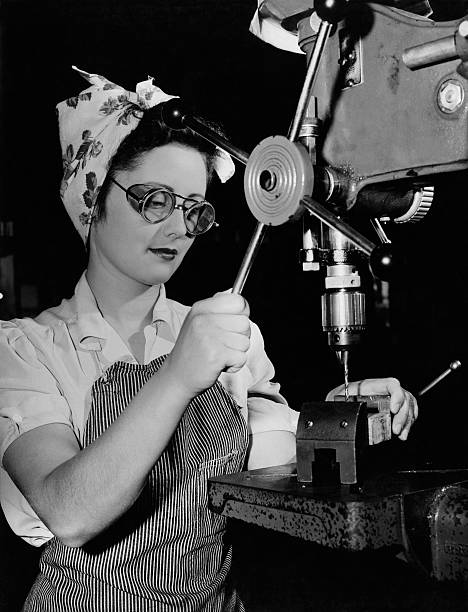
In the history of fashion and female emancipation, there are pivotal moments when clothing ceases to be a mere aesthetic choice and becomes a manifesto of freedom. As the catastrophic global conflicts of the 20th century swept across Europe and the Americas, drawing millions of men to the front lines, women stepped forward to take the wheel of daily survival. They discarded restrictive corsets, hid their silk skirts at the bottom of wardrobes, and, for the first time on a massive scale, donned utility trousers, denim overalls, and heavy leather boots. By stepping onto the floors of munitions factories, shipyards, and steel mills, these women did more than just fuel the defense machinery of their nations—they decisively and irrevocably demolished the patronizing myth that a woman’s place belongs solely in the kitchen.
Prior to the outbreak of world wars, the sight of a woman wearing trousers in public was still a scandalous anomaly. However, the grim realities of total industrial warfare dictated a new dress code: handling toxic chemicals, welding sparks, and operating heavy lathes required functional, safe attire.Women rapidly adapted this traditionally masculine garment, imprinting it with an entirely new symbolic weight. Bandanas tied tightly over their heads—originally meant to keep hair from being caught in moving machinery—became the crown of a new era. They stood as a badge of strength, grit, and self-reliance. Whether it was the British Munitionettes or the American workers personified by the iconic Rosie the Riveter, these women proved that femininity loses none of its power when covered in factory dust and grease.
For generations, patriarchal society fed the world a narrative of intrinsic female fragility, claiming women were biologically and emotionally hardwired only for domestic and caregiving roles. The brutal demands of the wartime defense industry exposed these claims as utter fiction.Women worked grueling night shifts, commanded heavy machinery, meticulously assembled bomb fuses, and orchestrated complex factory logistics. They displayed not only remarkable physical endurance but also a manual precision that frequently outmatched their male counterparts. In those dark, high-stakes years, a definitive paradigm shift occurred: if a woman can build a fighter plane or manufacture thousands of rounds of ammunition, no one has the right to confine her horizons to the kitchen sink.
Rebuilding a Broken World
When the guns finally fell silent, the monumental role of women did not simply come to an end. On the contrary, the titanic burden of lifting nations out of literal ash and rubble fell squarely onto their shoulders. In a devastated Europe facing a severe shortage of male labor, it was the women who cleared ruined cities brick by brick.From the famous Trümmerfrauen (Rubble Women) of Germany to the resilient female brigades clearing and rebuilding the historic streets of Warsaw, they mixed cement, laid bricks, and restored vital infrastructure. Without their sheer physical stamina and organizational genius, the post-war return to normalcy would have taken decades. Women did not just hold the world together during the chaos of war; they literally built it back up from the ground, wall by wall.
Legacy Etched in Denim
The wartime revolution in work and wardrobe permanently altered the landscape of labor and fashion. Trousers, once considered purely utilitarian workwear or a temporary wartime necessity, earned a permanent place in the modern woman’s wardrobe. Having tasted financial independence, professional respect, and social agency, women refused to be quietly ushered back into domestic isolation. Their unyielding spirit in the munitions bays and across post-war wreckage carved out the path for modern feminism, serving as permanent proof that the only limit to a woman’s capability is the one she chooses to set for herself. From the famous Trümmerfrauen (Rubble Women) of Germany to the resilient female brigades clearing and rebuilding the historic streets of Warsaw, they mixed cement, laid bricks, and restored vital infrastructure.
Without their sheer physical stamina and organizational genius, the post-war return to normalcy would have taken decades. Women did not just hold the world together during the chaos of war; they literally built it back up from the ground, wall by wall.