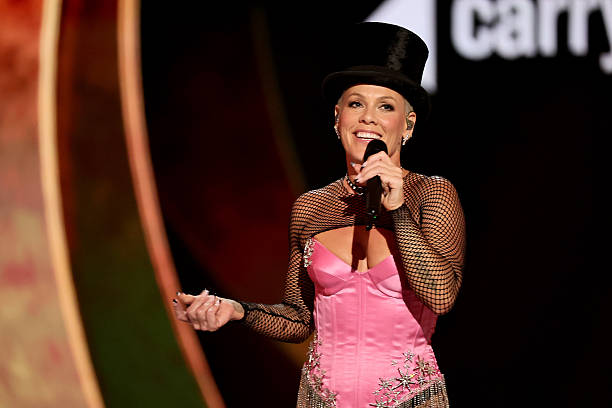
NEW YORK, NEW YORK - JUNE 07: P!NK performs onstage during The 79th Annual Tony Awards at Radio City Music Hall on June 07, 2026 in New York City. (Photo by Theo Wargo/Getty Images for Tony Awards Productions)
For over twenty years, Pink (Alecia Moore) has convinced us that she is a major rebel. She presented herself as a brave star who speaks her mind and fears no one. However, when you look closely at her biggest songs and career choices—from the famous anti-war hit “Dear Mr. President” to her behavior regarding the Middle East conflict—the truth turns out to be completely different. Her rebellion is simply a well-planned marketing strategy. Pink only gets involved in important issues when it pays off and when there is no risk of losing money.
Woman Who Fears Losing Customers
In 2006, Pink released the song “Dear Mr. President,” in which she sharply criticized the US President at the time, George W. Bush. She asked him directly how he could sleep at night while sending soldiers to the Iraq War and ignoring poor people. Fans praised her as a hero.
At that exact time, the atmosphere in America was so intense that criticizing the president could ruin a career. The country band The Chicks found this out the hard way when their songs were pulled from radio stations overnight. What did Pink do to avoid the same fate? She made a safe financial decision: she banned the song from being played on American radio stations. The song was only sold in Europe and Australia, where people already disliked Bush. Criticizing the government in front of an audience that is already cheering for you, while protecting your profits back home in the USA, is not bravery. It is just smart business.
Pink’s true colors came to light during the recent events in the Middle East. The artist, who has Jewish roots, immediately and harshly condemned Hamas’s brutal attack on Israel on October 7, 2023. She called Hamas terrorists and stood firmly by Israel. The problem started later. As the war escalated, thousands of civilians began dying in the Gaza Strip, and fans online started criticizing Pink for supporting only one side. Suddenly, her “bravery” completely vanished. During concerts in Germany, her dancers started waving colorful flags, which some people mistook for Israeli flags. A storm broke out. A panicked Pink quickly wrote on the internet:
“I do not use flags in my shows to make political statements. (…) I am a human being. I am for peace. I am for love.”
This is pure hypocrisy. A woman who wrote an entire song attacking the President of the United States suddenly claims that her stage is a “politics-free zone.” When things got heated, Pink hid behind safe, empty slogans about “love and peace.” She did this solely to avoid losing fans and harming her business.
Choosing What Is Convenient
Instead of fighting for real peace, Pink prefers to police other artists. She recently criticized rapper Macklemore, who wore a Palestinian scarf (keffiyeh) on stage and chanted slogans supporting Gaza. Pink even suggested that fans should get a refund for that performance.
This proves one thing: Pink has no problem with politics in music. She only has a problem with politics that Hollywood bosses dislike and that could hurt ticket sales.
Pink’s case is perfect proof of how today’s show business works. “Rebellion” is now just a product on a store shelf. Real rebels face consequences for their views—they lose contracts, money, and sometimes their freedom. Pink loses nothing. Her anger is staged and controlled, and when a real, difficult problem arises, she prefers to sing while hanging from a stadium ceiling and count the millions from expensive ticket sales.