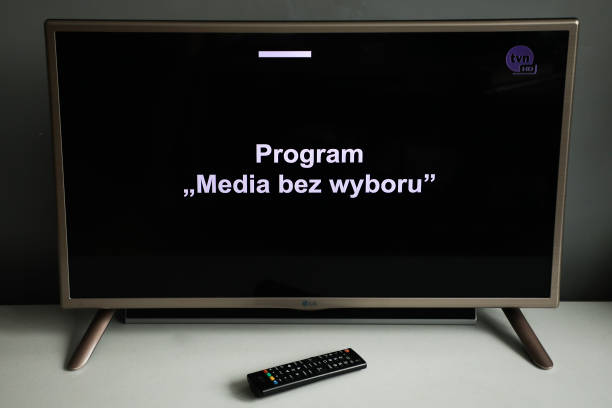
'Media Without Choice' protest declaration is screened on a TVN television channel. Krakow, Poland on February 10, 2021. Polish independent media suspended news coverage and the webpages of the countrys leading news organizations were blank Wednesday morning to protest a new advertising tax that broadcasters and publishers say is aimed not at raising money but at undermining the freedom of the press. (Photo by Beata Zawrzel/NurPhoto via Getty Images)
This isn’t just about one living room, though; it’s a snapshot of a much bigger, systemic story. Today’s news landscape has traded hard data and deep, meaningful storytelling for a loud, emotional spectacle designed not to inform, but to retain attention at all costs. We are witnessing the ultimate triumph of the attention economy, where information has been turned into a crowded theater of political drama and relentless advertisements. In this hyper-connected wilderness, complexity is flattened into soundbites, and nuance is sacrificed for outrage. The result is a profound civic tragedy: the machine leaves viewers with nothing but cognitive static instead of real, actionable understanding.
This toxic pivot is not an accident—it is the desperate, final gasp of a dying medium. Traditional linear television is fundamentally collapsing under the weight of its own obsolete architecture. The era of the rigid programming schedule, where audiences quietly waited for a specific hour to be told what was happening in the world, is gone forever. Streaming platforms and on-demand independent networks have fundamentally rewritten the rules of consumption, offering autonomy that cable TV simply cannot replicate.
As younger generations completely sever their cords, legacy networks have found themselves trapped in an existential death spiral. To survive financially amidst plummeting ratings, they have abandoned balanced journalism entirely, shifting their business models toward cheap-to-produce anger and hyper-partisan division. They are farming an aging, captive audience that remains tethered to the screen out of habit rather than trust. Traditional TV is no longer a cultural anchor; it has become an echo chamber of curated fear, heavily subsidized by pharmaceutical ads and political action committees.
For those of us building the future in technology and new media, this crisis cannot be ignored—this is our quiet, yet urgent call to action. We are the architects of the new digital infrastructure, and we bear the responsibility for the ecosystems we create. There is a growing, aching need for alternative spaces that deliberately filter out the algorithmic chaos, dismantle the polarization loops, and restore high-quality, honest truth to the center of public discourse. It is no longer enough to build platforms that are merely fast or engaging; we must build platforms that are trustworthy. It’s time for us to take the older generation by the hand—those who are currently left stranded by the decay of traditional television and are most vulnerable to the flood of deepfakes, clickbait, and state-sponsored propaganda—and safely guide them toward modern, independent platforms where the truth still speaks clearly, and where human dignity is valued above ad clicks.